Byzantique

Mark 9

4 notes
Text · Mark 9

1And he said to them, “Truly I say to you, there are some standing here who will certainly not taste death until they see the kingdom of God come with power.”

The Transfiguration

2After six days Jesus took Peter, James, and John, and led them up on a high mountain by themselves. There he was transfigured before them. 3His garments became radiant and extremely white, alike snow, such as no launderer on earth could whiten them. 4Then Elijah appeared to them with Moses, and they were talking with Jesus. 5So Peter said to Jesus, “Rabbi, it is good for us to be here. Let us make three shelters, one for yoʋ, one for Moses, and one for Elijah.” 6(For they were terrified, and he did not know bwhat to say.) 7Then a cloud came and overshadowed them, and a voice came from the ccloud: “This is my beloved Son; listen to him!” 8And suddenly, when they looked around, they no longer saw anyone with them but Jesus.

9As they were coming down from the mountain, Jesus ordered them to tell no one what they had seen until the Son of Man had risen from the dead. 10So they kept the matter to themselves, discussing what this “rising from the dead” could mean. 11Then they asked him, “Why do the scribes say that Elijah must come first?” 12He danswered them, “Elijah does indeed come first to restore all things. How then is it written that the Son of Man must suffer many things and be treated with contempt? 13But I tell you that Elijah has indeed come, and they did to him whatever they wanted, just as it is written about him.”

Jesus Heals a Boy with an Unclean Spirit

14When eJesus came back to the other disciples, he saw a large crowd around them, and some scribes arguing with them. 15When the whole crowd saw him, they were greatly amazed and immediately ran up and greeted him. 16Then he asked fthe scribes, “What are you arguing gwith them about?” 17One man from among the crowd hanswered, “Teacher, I brought yoʋ my son, who has a spirit that makes him mute. 18Whenever it seizes him, it throws him down, and he foams at the mouth, grinds his teeth, and becomes rigid. I asked yoʋr disciples to cast it out, but they were not able to do so.” 19Jesus answered ihim, “O faithless generation, how long shall I be with you? How long shall I bear with you? Bring him to me.” 20So they brought the boy to him. When the spirit saw Jesus, it immediately threw the boy into convulsions, and he fell on the ground and rolled around, foaming at the mouth. 21Then Jesus asked the boy's father, “How long has this been happening to him?” The father said, “From childhood. 22It often throws him into the fire and into the water to destroy him. But if yoʋ are able to do anything, help us and have compassion on us.” 23Jesus said to him, “ jThe question is whether yoʋ are able to believe; all things are possible for the one who believes.” 24Immediately the child's father cried out and said kwith tears, “I lbelieve, Lord; help my unbelief!” 25When Jesus saw that ma crowd came running together, he rebuked the unclean spirit and said to it, “Yoʋ spirit that makes this boy mute and deaf, I command yoʋ, come out of him and never enter him again!” 26After crying out, the spirit convulsed the boy greatly and came out, and the boy became as though he were dead, so that many said, “He is dead!” 27But Jesus took him by the hand and raised him up, and the boy arose. 28Now when Jesus came into the house, his disciples asked him privately, “Why could we not cast it out?” 29He said to them, “This kind cannot come out by anything except prayer nand fasting.”

Jesus Predicts His Death and Resurrection a Second Time

30Then they went away from there and opassed through Galilee, but Jesus did not want anyone to know it. 31For he was teaching his disciples and telling them, “The Son of Man is going to be delivered up into the hands of men, and they will kill him. Yet pafter he has been killed, he will rise on the third day.” 32But they did not understand what this meant, and they were afraid to ask him about it.

True Greatness

33Then qJesus came to Capernaum, and when he was in the house, he asked the disciples, “What were you discussing ramong yourselves on the way?” 34But they were silent, because on the way they had been arguing with one another about who was greater. 35So Jesus sat down, called the twelve over, and said to them, “If anyone wants to be first, he must be last of all and a servant to all.” 36Then he took a child and placed him before them. And taking the child in his arms, he said to them, 37“Whoever receives one child such as this in my name receives me; and whoever receives me, receives not me, but him who sent me.”

Whoever Is Not Against You Is for You

38John said to him sin response, “Teacher, we saw someone twho does not follow us casting out demons in yoʋr name, and we told him to stop because he does not follow us.” 39But Jesus said, “Do not stop him, for no one who does a miracle in my name will be able to speak evil of me soon afterward. 40For whoever is not against uyou is for you. 41Truly I say to you, whoever gives you a cup of water to drink vin my name, because you belong to Christ, will certainly not lose his reward.

Temptations to Sin

42“If anyone causes one of wthe little ones who believe xin me to stumble, it would be better for him if a ymillstone were hung around his neck and he were thrown into the sea. 43If yoʋr hand causes yoʋ to stumble, cut it off. It is better for yoʋ to enter life crippled than to have two hands and go into hell, into the unquenchable zfire, 44‘where their worm does not die and the fire is not quenched.’ 45And if yoʋr foot causes yoʋ to stumble, cut it off. aaIt is better for yoʋ to enter life lame than to have two feet and be thrown into abhell, into the unquenchable fire, 46‘where their worm does not die and the fire is not quenched.’ 47And if yoʋr eye causes yoʋ to stumble, tear it out. It is better for yoʋ to enter the kingdom of God with one eye than to have two eyes and acbe thrown into adthe fires of hell, 48‘where aetheir worm does not die and the fire is not quenched.’ 49For everyone will be salted with affire, and every sacrifice will be seasoned with salt. 50Salt is good, but if it becomes unsalty, with what shall you season it? Have salt in yourselves, and be at peace with one another.”
Textual notes
  • a9:3like snow, 𝔐890 70.6% • 𝔐343 24.1% ¦ — CT 0.9%
  • b9:6what to say ¦ how to respond CT
  • c9:7cloud: ¦ cloud, saying, ANT TR
  • d9:12answered ¦ said to CT
  • e9:14Jesus came back to the other disciples, he ¦ they came back to the other disciples, they CT
  • f9:16the scribes ¦ them CT
  • g9:16with them about ¦ about among yourselves ANT SBL
  • h9:17answered ¦ answered him CT
  • i9:19him ¦ them CT
  • j9:23The question is whether yoʋ are able to believe. ¦ ‘If yoʋ are able’? CT
  • k9:24with tears 96.5% ¦ — CT 0.9%
  • l9:24believe, Lord; ¦ believe; CT
  • m9:25a 𝔐28 ¦ the 𝔐16 PCK
  • n9:29and fasting ECM† 99.7% ¦ — NA SBL WH 0.2%
  • o9:30passed ¦ went WH
  • p9:31after he has been killed, he will rise on the third day ¦ when he is killed, after three days he will rise CT
  • q9:33Jesus ¦ they CT
  • r9:33among yourselves ¦ — CT
  • s9:38in response ¦ — CT
  • t9:38who does not follow us casting out demons in yoʋr name, and we told him to stop because he does not follow us. 82.4% ¦ who does not follow us casting out demons in yoʋr name. MSS 7.2% ¦ casting out demons in yoʋr name, and we told him to stop because he was not following us. CT 0.7%
  • u9:40you is for you ¦ us is for us CT SCR
  • v9:41in my name, because you belong to Christ, 76.8% • ANT TR 17.2% ¦ because you bear the name of Christ CT 4.6%
  • w9:42the ECM† ¦ these ANT CT SCR
  • x9:42in me ¦ — WH
  • y9:42millstone ¦ heavy millstone CT
  • z9:43fire, ‘where their worm does not die and the fire is not quenched.’ ¦ fire. SBL TH WH {Note: NA encloses where their worm does not die and the fire is not quenched with double brackets.}
  • aa9:45It 𝔐18 ¦ For it 𝔐7
  • ab9:45hell, into the unquenchable fire, ‘where their worm does not die and the fire is not quenched.’ ¦ hell, ‘where their worm does not die and the fire is not quenched.’ NA ¦ hell. SBL TH WH {Note: NA encloses where their worm does not die and the fire is not quenched with double brackets.}
  • ac9:47be thrown ¦ go away ANT
  • ad9:47the fires of hell 97% ¦ hell CT 1.2%
  • ae9:48their ¦ the PCK
  • af9:49fire, and every sacrifice will be seasoned with salt. 83.3% ¦ fire. CT 6.6%
Commentary
RangeMark 9:1–13

Emphasis on Elijah

Among the parallel accounts of the Transfiguration (Matthew 17:1-9; Luke 9:28-36), St. Mark emphasizes the appearance of Elijah, responding to the disciples' expectations from the prophecy in Malachi 3:22–23.1 This follows from questions such as in 8:27-28.

Fr. Pat Reardon suggested that the Transfiguration account was interpolated into St. Mark's Gospel amidst a section about Elijah's return.2 However, other commentators suggest the opposite (i.e., the Transfiguration account is original but the surrounding discussion of Elijah was interpolated), and beginning with Wellhausen, others such as Bultmann have even suggested that this was originally an account of the resurrection (which has largely been discredited).3

  • 1Greek LXX citation; Malachi 4:5 in the Hebrew MT. Jesus ben Sirach (Ecclesiasticus) may also have alluded to Elijah's return (cf. Wisdom of Sirach 48:10).
  • 2Patrick Henry Reardon, Reclaiming the Atonement: An Orthodox Theology of Redemption: The Incarnate Word, vol. 1 (Chesterton, IN: Ancient Faith Publishing, 2015), 248–249. I am not aware of any other commentators that assert this, and Reardon cited no support beyond internal evidence of how the passage reads absent the Transfiguration account.
  • 3Cf., e.g, Craig A. Evans, Mark 8:27–16:20, vol. 34B, Word Biblical Commentary (Dallas: Word, Incorporated, 2001), 33; Adela Yarbro Collins and Harold W. Attridge, Mark: A Commentary on the Gospel of Mark, Hermeneia—A Critical and Historical Commentary on the Bible (Minneapolis, MN: Fortress Press, 2007), 414–415.
VerseMark 9:2

High mountain

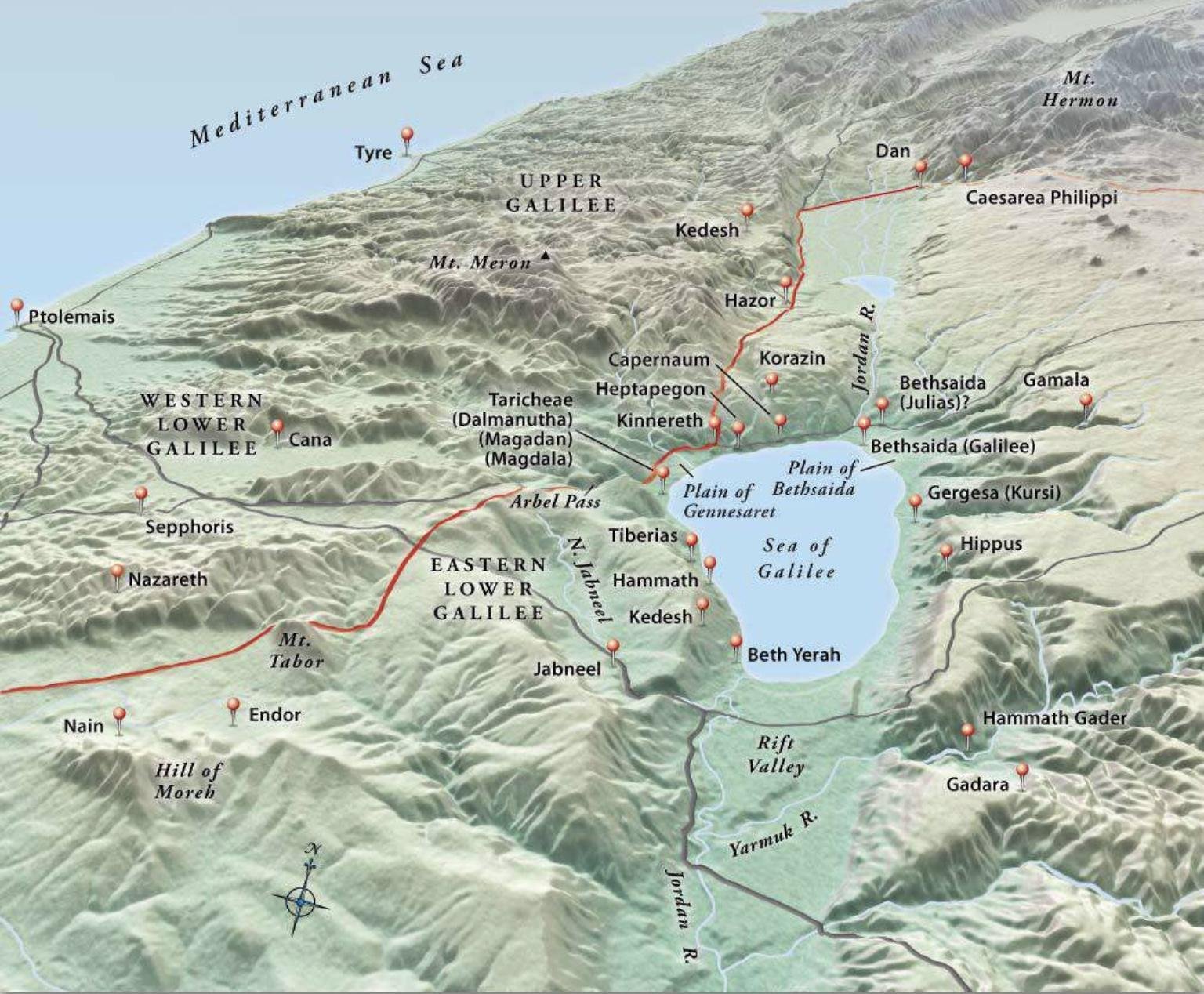
Jesus and His disciples are in the region of Caesarea Philippi (cf. 8:27), which is at the base of Mt. Hermon. As such, the most likely mountain where the Transfiguration took place is Mt. Hermon (look towards the top right of the below map).1

Map of northern Israel showing Caesarea Philippi at the base of Mt. Hermon and Mt. Tabor can be seen west of the Sea of Galilee

However, the early Church in Palestine associated the Transfiguration with Mt. Tabor as early as the fourth century2 (look towards the bottom left of the above map), and the Orthodox Church continues to maintain this association in its hymnography for the feast.

The Festal Menaion interestingly includes Psalm 88(89):13 in various places, including as the prokeimenon before the Matins Gospel reading for the feast of Transfiguration: "Tabor and Hermon shall rejoice in Thy Name!"3

  • 1Map credit: Aaron Shust, "The Gates of Hell," Land of Zion. Retrieved from https://www.landofzion.org/stories/cp
  • 2Cf., e.g., Lev Gillet, The Year of Grace of the Lord: A Scriptural and Liturgical Commentary on the Calendar of the Orthodox Church, trans. Deborah Cowen (Crestwood, NY: St. Vladimir’s Seminary Press, 1980), 253 at fn61.
  • 3Mother Mary and Kallistos Ware, trans., The Festal Menaion, Third Printing 1998, The Service Books of the Orthodox Church (South Canaan, PA: St. Tikhon’s Seminary Press, 1969), 469, 477, 480.
VerseMark 9:2

Six days: From Mt. Sinai to Mt. Tabor

The "six days" likely ties this account to Moses' ascent of Mt. Sinai in Exodus 24 (cf. especially 24:16).

Similarly, Moses ascended with two companions who were brothers (Nadab and Abihu), just as Peter did with James and John.

A number of features parallel these accounts:

Mark's other details of the Transfiguration, such as the mountain (9:2), the glorious light (9:3), and the divine voice coming from the cloud (9:7), correspond to identical particulars in the scene on Mount Sinai (Ex. 24:1–2, 15–16). In short, Mark understands the Transfiguration to be strictly theophanic, an appearance of God. In this respect, the true correspondence to Mount Sinai is Jesus Himself, who has now become the place of God's presence and revelation.1

  • 1Patrick Henry Reardon, Reclaiming the Atonement: An Orthodox Theology of Redemption: The Incarnate Word, vol. 1 (Chesterton, IN: Ancient Faith Publishing, 2015), 252.
VerseMark 9:8

The Law (Moses) and the Prophets (Elijah) point to Jesus

Mark ends the story with the uniqueness of Jesus: "Suddenly, when they had looked around, they saw no one anymore, but only Jesus with themselves" (Mark 9:8). The Law (Moses) and the Prophets (Elijah), having their full and intended meaning in the vision of the glorified Christ, disappear from the scene on the mountain. There remains only Jesus, concerning whom the divine voice, coming out of the cloud, announces, "This is My beloved Son. Hear him!" (9:7).1

  • 1Patrick Henry Reardon, Reclaiming the Atonement: An Orthodox Theology of Redemption: The Incarnate Word, vol. 1 (Chesterton, IN: Ancient Faith Publishing, 2015), 253.
Synoptic parallels
  • 9:2–13 The Transfiguration

    The Transfiguration

    3 Gospels · read side by side
    Mark 9:2–13 · this chapter
    Read with commentary →✎ 4 notes
    2After six days Jesus took Peter, James, and John, and led them up on a high mountain by themselves. There he was transfigured before them. 3His garments became radiant and extremely white, like snow, such as no launderer on earth could whiten them. 4Then Elijah appeared to them with Moses, and they were talking with Jesus. 5So Peter said to Jesus, “Rabbi, it is good for us to be here. Let us make three shelters, one for yoʋ, one for Moses, and one for Elijah.” 6(For they were terrified, and he did not know what to say.) 7Then a cloud came and overshadowed them, and a voice came from the cloud: “This is my beloved Son; listen to him!” 8And suddenly, when they looked around, they no longer saw anyone with them but Jesus. 9As they were coming down from the mountain, Jesus ordered them to tell no one what they had seen until the Son of Man had risen from the dead. 10So they kept the matter to themselves, discussing what this “rising from the dead” could mean. 11Then they asked him, “Why do the scribes say that Elijah must come first?” 12He answered them, “Elijah does indeed come first to restore all things. How then is it written that the Son of Man must suffer many things and be treated with contempt? 13But I tell you that Elijah has indeed come, and they did to him whatever they wanted, just as it is written about him.”
    Matthew 17:1–13
    Read with commentary →✎ 3 notes
    1After six days Jesus took Peter, James, and John the brother of James, and led them up on a high mountain by themselves. 2There he was transfigured before them; his face shone like the sun, and his garments became as white as light. 3And behold, Moses and Elijah appeared to them, talking with him. 4So Peter said to Jesus, “Lord, it is good for us to be here. If yoʋ want, we will make three shelters here, one for yoʋ, one for Moses, and one for Elijah.” 5While he was still speaking, behold, a bright cloud overshadowed them, and a voice from the cloud said, “This is my beloved Son, in whom I am well pleased; listen to him!” 6When the disciples heard this, they fell on their faces and were utterly afraid. 7But Jesus came over and touched them, saying, “Rise; do not be afraid.” 8And lifting up their eyes, they saw no one but Jesus. 9As they were coming down from the mountain, Jesus commanded them, “Do not tell anyone about the vision you saw until the Son of Man has risen from the dead.” 10Then his disciples asked him, “Why do the scribes say that Elijah must come first?” 11Jesus answered them, “Elijah does indeed come first, and he will restore all things. 12But I tell you that Elijah has already come, and they did not recognize him, but did to him whatever they wanted. Even so the Son of Man is about to suffer at their hands.” 13Then the disciples understood that he was speaking to them about John the Baptist.
    Luke 9:28–36
    Read with commentary →✎ 3 notes
    28About eight days after he had spoken these words, he took Peter, John, and James, and went up on a mountain to pray. 29As he was praying, the appearance of his face was altered, and his clothing became dazzling white. 30And behold, two men were talking with him; they were Moses and Elijah, 31who appeared in glory and were speaking about his departure, which he was about to bring to fulfillment in Jerusalem. 32Now Peter and those who were with him were heavy with sleep, but when they became fully awake, they saw his glory and the two men standing with him. 33As the men were parting from Jesus, Peter said to him, “Master, it is good for us to be here. Let us make three shelters, one for yoʋ, one for Moses, and one for Elijah,” not knowing what he was saying. 34But as he was saying this, a cloud came and overshadowed them, and they were afraid as they entered the cloud. 35Then a voice came from the cloud, saying, “This is my beloved Son; listen to him!” 36When the voice finished speaking, they found that Jesus was alone. And the disciples kept silent, not telling anyone in those days about any of the things they had seen.
    Esc or click outside to close
  • 9:14–29 The Epileptic Boy

    The Epileptic Boy

    3 Gospels · read side by side
    Mark 9:14–29 · this chapter
    Read with commentary →
    14When Jesus came back to the other disciples, he saw a large crowd around them, and some scribes arguing with them. 15When the whole crowd saw him, they were greatly amazed and immediately ran up and greeted him. 16Then he asked the scribes, “What are you arguing with them about?” 17One man from among the crowd answered, “Teacher, I brought yoʋ my son, who has a spirit that makes him mute. 18Whenever it seizes him, it throws him down, and he foams at the mouth, grinds his teeth, and becomes rigid. I asked yoʋr disciples to cast it out, but they were not able to do so.” 19Jesus answered him, “O faithless generation, how long shall I be with you? How long shall I bear with you? Bring him to me.” 20So they brought the boy to him. When the spirit saw Jesus, it immediately threw the boy into convulsions, and he fell on the ground and rolled around, foaming at the mouth. 21Then Jesus asked the boy's father, “How long has this been happening to him?” The father said, “From childhood. 22It often throws him into the fire and into the water to destroy him. But if yoʋ are able to do anything, help us and have compassion on us.” 23Jesus said to him, “ The question is whether yoʋ are able to believe; all things are possible for the one who believes.” 24Immediately the child's father cried out and said with tears, “I believe, Lord; help my unbelief!” 25When Jesus saw that a crowd came running together, he rebuked the unclean spirit and said to it, “Yoʋ spirit that makes this boy mute and deaf, I command yoʋ, come out of him and never enter him again!” 26After crying out, the spirit convulsed the boy greatly and came out, and the boy became as though he were dead, so that many said, “He is dead!” 27But Jesus took him by the hand and raised him up, and the boy arose. 28Now when Jesus came into the house, his disciples asked him privately, “Why could we not cast it out?” 29He said to them, “This kind cannot come out by anything except prayer and fasting.”
    Matthew 17:14–21
    Read with commentary →
    14When they came to the crowd, a man approached Jesus, kneeling before him 15and saying, “Lord, have mercy on my son, for he is an epileptic and suffers terribly. For often he falls into the fire, and often into the water. 16I brought him to yoʋr disciples, but they could not heal him.” 17Jesus answered, “O faithless and perverse generation, how long shall I be with you? How long shall I bear with you? Bring him here to me.” 18Then Jesus rebuked the demon, and it came out of the boy, and he was healed from that hour. 19Afterward the disciples came to Jesus privately and said, “Why could we not cast it out?” 20Jesus said to them, “Because of your unbelief. For truly I say to you, if you have faith like a grain of mustard seed, you will say to this mountain, ‘Move from here to there,’ and it will move. Nothing will be impossible for you. 21But this kind does not go out except by prayer and fasting.”
    37On the next day, when they came down from the mountain, Jesus was met by a large crowd. 38And behold, a man from among the crowd cried out, “Teacher, I beg yoʋ to look at my son, for he is my one and only child. 39A spirit seizes him, and he suddenly cries out; it convulses him so that he foams at the mouth. It hardly ever leaves him alone, bruising him severely. 40I begged yoʋr disciples to cast it out, but they could not.” 41Jesus answered, “O faithless and perverse generation, how long shall I be with you and bear with you? Bring yoʋr son here.” 42Now as the boy was approaching, the demon threw him down and shook him with convulsions. But Jesus rebuked the unclean spirit, healed the boy, and gave him back to his father. 43And they were all astonished at the majesty of God. But while everyone was marveling at all that Jesus had done, he said to his disciples,
    Esc or click outside to close
  • 9:30–32 The Second Passion Prediction

    The Second Passion Prediction

    3 Gospels · read side by side
    Mark 9:30–32 · this chapter
    Read with commentary →
    30Then they went away from there and passed through Galilee, but Jesus did not want anyone to know it. 31For he was teaching his disciples and telling them, “The Son of Man is going to be delivered up into the hands of men, and they will kill him. Yet after he has been killed, he will rise on the third day.” 32But they did not understand what this meant, and they were afraid to ask him about it.
    Matthew 17:22–23
    Read with commentary →
    22While they were staying in Galilee, Jesus said to them, “The Son of Man is about to be delivered up into the hands of men. 23They will kill him, and on the third day he will be raised up.” And the disciples were greatly distressed.
    43And they were all astonished at the majesty of God. But while everyone was marveling at all that Jesus had done, he said to his disciples, 44“Let these words sink into your ears: The Son of Man is about to be delivered up into the hands of men.” 45But they did not understand what this meant. It was concealed from them, so that they could not grasp it, and they were afraid to ask him about it.
    Esc or click outside to close
  • 9:33–37 Who Is the Greatest

    Who Is the Greatest

    3 Gospels · read side by side
    Mark 9:33–37 · this chapter
    Read with commentary →
    33Then Jesus came to Capernaum, and when he was in the house, he asked the disciples, “What were you discussing among yourselves on the way?” 34But they were silent, because on the way they had been arguing with one another about who was greater. 35So Jesus sat down, called the twelve over, and said to them, “If anyone wants to be first, he must be last of all and a servant to all.” 36Then he took a child and placed him before them. And taking the child in his arms, he said to them, 37“Whoever receives one child such as this in my name receives me; and whoever receives me, receives not me, but him who sent me.”
    Matthew 18:1–5
    Read with commentary →
    1In that hour the disciples came to Jesus and said, “Who is greater in the kingdom of heaven?” 2So Jesus called over a little child, placed him among them, 3and said, “Truly I say to you, unless you change and become like little children, you will certainly not enter the kingdom of heaven. 4Therefore, whoever humbles himself like this little child is greater in the kingdom of heaven. 5And whoever receives one little child such as this in my name receives me.
    46Now an argument arose among the disciples as to which of them was greater. 47But Jesus, perceiving the thoughts of their hearts, took a child and placed him by his side. 48Then he said to them, “Whoever receives this child in my name receives me, and whoever receives me receives him who sent me. For he who is least among you all is the one who will be great.”
    Esc or click outside to close
  • 9:38–41 The Strange Exorcist

    The Strange Exorcist

    2 Gospels · read side by side
    Mark 9:38–41 · this chapter
    Read with commentary →
    38John said to him in response, “Teacher, we saw someone who does not follow us casting out demons in yoʋr name, and we told him to stop because he does not follow us.” 39But Jesus said, “Do not stop him, for no one who does a miracle in my name will be able to speak evil of me soon afterward. 40For whoever is not against you is for you. 41Truly I say to you, whoever gives you a cup of water to drink in my name, because you belong to Christ, will certainly not lose his reward.
    49John responded, “Master, we saw someone casting out demons in yoʋr name, and we told him to stop because he does not follow us.” 50But Jesus said to him, “Do not stop him, for whoever is not against us is for us.”
    Esc or click outside to close
  • 9:42–50 Temptations to Sin

    Temptations to Sin

    2 Gospels · read side by side
    Mark 9:42–50 · this chapter
    Read with commentary →
    42“If anyone causes one of the little ones who believe in me to stumble, it would be better for him if a millstone were hung around his neck and he were thrown into the sea. 43If yoʋr hand causes yoʋ to stumble, cut it off. It is better for yoʋ to enter life crippled than to have two hands and go into hell, into the unquenchable fire, 44‘where their worm does not die and the fire is not quenched.’ 45And if yoʋr foot causes yoʋ to stumble, cut it off. It is better for yoʋ to enter life lame than to have two feet and be thrown into hell, into the unquenchable fire, 46‘where their worm does not die and the fire is not quenched.’ 47And if yoʋr eye causes yoʋ to stumble, tear it out. It is better for yoʋ to enter the kingdom of God with one eye than to have two eyes and be thrown into the fires of hell, 48‘where their worm does not die and the fire is not quenched.’ 49For everyone will be salted with fire, and every sacrifice will be seasoned with salt. 50Salt is good, but if it becomes unsalty, with what shall you season it? Have salt in yourselves, and be at peace with one another.”
    Matthew 18:6–9
    Read with commentary →
    6But if anyone causes one of these little ones who believe in me to stumble, it would be better for him to have a heavy millstone hung around his neck and to be drowned in the depths of the sea. 7“Woe to the world because of stumbling blocks! It is necessary that stumbling blocks come, yet woe to that man through whom the stumbling block comes! 8If yoʋr hand or yoʋr foot causes yoʋ to stumble, cut them off and throw them away from yoʋ. It is better for yoʋ to enter life lame or crippled than to have two hands or two feet and be thrown into the eternal fire. 9And if yoʋr eye causes yoʋ to stumble, pluck it out and throw it away from yoʋ. It is better for yoʋ to enter life with one eye than to have two eyes and be thrown into the fires of hell.
    Esc or click outside to close

New Testament text: Text-Critical English New Testament (TCENT) — © Robert Adam Boyd, CC BY 4.0. Texts & Translations →